Home · About
Sanskrit Scholar · Yoga Philosopher · Educator · Carnatic Vocalist · Nāda Yoga Practitioner
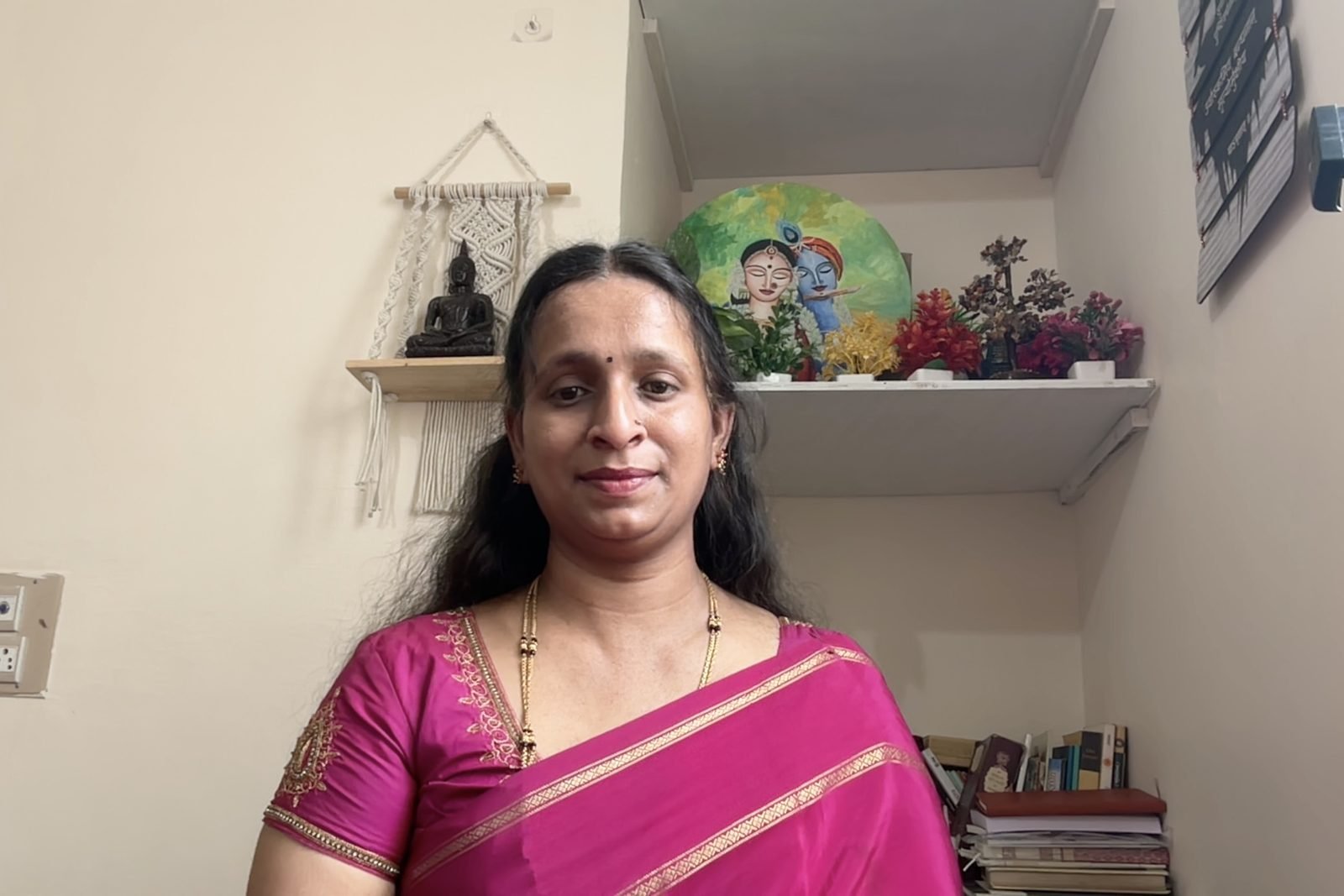
Yogashree MV is a Sanskrit scholar, yoga philosopher, educator, Carnatic classical vocalist, Veena practitioner and teacher, dedicated to preserving, studying and sharing India's profound spiritual and intellectual traditions.
Her work brings together Sanskrit, Yoga Darśana, the Bhagavad Gītā, the Yoga Sūtras, Vedic chanting, Indian philosophy, Carnatic music, Nāda Yoga and the traditional Indian knowledge systems — creating a bridge between ancient wisdom and contemporary learning.
With more than fifteen years of teaching experience, she has worked with students of many ages and backgrounds, in India and internationally.
Her approach rests on the belief that the Indian knowledge traditions are not merely subjects to be studied intellectually, but living traditions to be experienced — through study, contemplation, practice, sound, music, meditation and self-inquiry.
Yoga Samādhi — एकं विमर्शात्मकम् अध्ययनम्
The research explores the concept of samādhi in the Yoga tradition: its philosophical foundations, classifications, methods, obstacles and transformative dimensions — and its relationship with contemporary approaches to consciousness and transpersonal psychology.
Sources engaged include the Pātañjala Yoga Sūtras, the Vyāsa Bhāṣya, the Bhagavad Gītā, the Upaniṣads and Yoga Upaniṣads, classical Yoga literature, Indian philosophical traditions, and modern and transpersonal psychology.
Over fifteen years, teaching both academic and traditional subjects, to learners ranging from school students to adult practitioners and international students.
Her teaching method combines traditional textual learning with practical experience, so that students understand not only what a text says, but how its teaching can be carried into daily life and personal practice.
For Yogashree, yoga is much more than physical exercise. Her teaching is shaped by the philosophical foundations of yoga — particularly Patañjali, the Bhagavad Gītā and the Upaniṣadic tradition.
She explores yoga as a path involving the whole person:
शरीरम् · प्राणः · मनः · बुद्धिः · आत्मा
śarīra — body · prāṇa — vital energy · manas — mind · buddhi — discernment · ātman — Self
Music is an equal dimension of Yogashree's work. Trained in Carnatic classical vocal music and in Veena, she explores the relationship between music, sound, consciousness and spiritual practice.
Her approach to Nāda Yoga takes up the traditional Indian understanding of nāda — sound as a pathway to inner awareness — bringing together nāda, śabda, mantra, voice, breath, concentration, listening, bhāva and devotional music.
She conducts online Carnatic vocal classes through her music initiative Anāhata, where students learn the foundations and the discipline of Indian classical vocal music: śruti awareness, tāla, voice culture, swara, rāga, gīti, kīrtana and classical compositions.
She has a particular interest in Sanskrit pronunciation, mantra and traditional chanting, and her chanting programmes take up correct pronunciation, svara, mātrā, uccāraṇa, anusvāra, visarga and the principles of Vedic recitation.
Her chanting repertoire includes traditional Vedic and Sanskrit chants — sūktas, selected Upaniṣadic mantras and traditional prayers — taught so that students develop both accuracy of pronunciation and an experiential relationship with sacred sound.
She believes music can be not only an artistic discipline but a means of inner refinement, concentration and self-exploration.
One distinctive aspect of Yogashree's work is her interest in bringing traditional Indian philosophy into dialogue with contemporary thought. Her academic interests include the relationship between yoga, consciousness and modern psychology — particularly transpersonal psychology.
Her doctoral research examines traditional accounts of higher states of consciousness alongside contemporary perspectives on consciousness and human transformation. The aim is not to reduce traditional yoga to modern psychology, but to create a genuine academic dialogue between the two frameworks.
To create a space where people from India and around the world can authentically engage with the wisdom traditions of India — making Sanskrit texts, yoga philosophy, chanting, music and Indian spiritual traditions accessible, meaningful and relevant to contemporary learners.
The larger vision is a learning ecosystem where Sanskrit, yoga, philosophy, music and contemplative practice come together. Students from any cultural or academic background are welcome; these traditions can be approached by anyone with curiosity, sincerity and a willingness to learn.
Whether you are entirely new to Sanskrit and Indian philosophy, or already have years of practice behind you, there is a way in. Send a message and we will find the right starting point together.